What is Karate?
Adult advanced training methods
What is Karate?
Karate translates to “empty hand.” The Shi Zen Do Karate system is rooted in the traditional styles of Wado Ryu—founded by Hironori Ohtsuka—and Goju Ryu—founded by Chojun Miyagi. Both systems draw deeply from Okinawan and Japanese martial arts traditions. Shi Zen Do also incorporates Chinese concepts and principles, blending these methods to enrich and refine our empty‑hand practice. This approach allows us to look back through history for inspiration, giving the system a distinctive perspective while deepening our understanding of Karate. The “roots and branches” concept reflects the historical development of martial arts within the Shi Zen Do training syllabus.
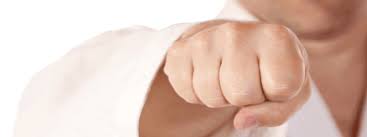
The Wado Ryu badge, featuring a dove of peace and a clenched fist, captures the essence of the system. The dove represents peace and harmony, while the fist symbolizes the strength required to maintain that balance. To cultivate inner peace and a resilient spirit, one must first train the physical self. A powerful fist is meaningless if the Karateka lacks emotional and spiritual control. Achieving harmony between these aspects is essential. The circular shape of the badge reinforces Wado Ryu’s soft, flowing nature, reflecting the circular movements characteristic of the style. It also serves as a reminder that training is a continuous, lifelong cycle of improvement.
At the core of the Karate system are the Katas—pre‑arranged forms. The physical purpose of Kata training is to strengthen bones, muscles, and ligaments while maximizing biomechanical efficiency. This develops quick reflexes and fluid movement, enabling practitioners to respond rapidly across the body’s natural range of motion. The principal Katas of the Wado Ryu system—often considered its four jewels—are Naihanchi, Kushanku, Seishan, and Chinto, along with the Goju Ryu forms Sanchin and Tensho.
Historically, Katas served as teaching tools, preserving effective combat techniques and passing them from one generation to the next. Their primary goal is to transmit proven methods and cultivate practical self‑defence skills. Through consistent, repetitive practice, the Karateka internalizes these movements until they can be executed naturally and instinctively.
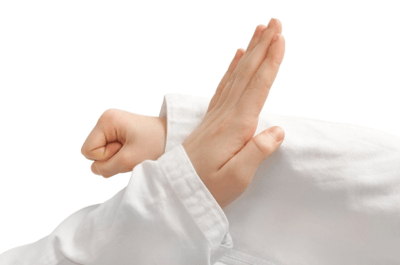
The Chinese systems of Wing Chun and Tai Chi Chuan use “sticky hands” training, known as Chi Sau. Karate has its own equivalent in Kake Uke—often translated as “sticky hands” or “entangling hands.” These methods cultivate sensitivity and tactile awareness, enabling practitioners to respond effectively in close‑quarter combat. Kake represents softness, while Juken refers to the art of sensitivity and receptivity. Once contact is made and sensitivity is established, explosive power can be released and focused precisely onto the opponent—kimae.
Shizendo Karate incorporates these principles through the practices of Kake and Tegumi. Tegumi–Kake are pre‑arranged paired hand drills that develop touch reflex and tactile sensitivity. Through these drills, the deeper lessons and hidden applications of the Karate Katas are revealed. This training naturally progresses into close‑range freestyle sparring.
The four fundamental arm techniques—upper, lower, inner, and outer uke (meaning “to receive”)—form the basis of these hand drills. Every Kata bunkai (application) can be explored at this close range: punches, kicks, locks, throws, takedowns, and more. This is the true range of Kata. Here, the Karateka applies the techniques learned in Kata and refines them through the hand drills, developing understanding of distance, tactile “stickiness,” and efficient power generation through partnered practice. Mastering these drills is one of the most important steps toward understanding Shizendo Karate.
Karate is the art of controlling or defending oneself through joint manipulation (Kensetsu), grappling (Tuite), and striking. When Tegumi is combined with Tuite and Kensetsu, it provides an almost limitless range of responses to any attack, all rooted in the principles and concepts found within the Katas. The application of Kata offers only a glimpse of its potential; the true value lies in the underlying principles.
With time, Tegumi–Kake training develops the ability to apply techniques spontaneously—flowing from one response to another while maintaining control through manipulation and impact. This training nurtures the capacity to flow, which is essential. Without flow, there can be no change; without change, there can be no effective response to the countless variations of attack. Flow is the art—without flow, there is no art.
“Tradition should inspire innovation not limit it”
Tegumi ——— Flowing hands
Tuite ————- Grasping hands
Kensetsu —— Joint locking hands
Kake ————- Sticky hands
Shi Zen Do means “Natural relaxed” or “Natures Way”, an encompassing term in which a person remains naturally relaxed but alert. This is reflected both physically and mentally thus developing a strong spirit. All movements are subject to the laws of nature. The word “Do”, when used as a suffix to a particular style of Japanese Martial Arts, is indicative of more than just a means of combat. “Do” indicates a discipline and philosophy with moral and spiritual connotations, the ultimate aim being enlightenment through personal development.
hi Zen Do translates as “natural relaxation” or “nature’s way,” a term that reflects a state in which a person remains calm, centred, and alert. This quality is expressed both physically and mentally, helping to cultivate a strong and resilient spirit. All movement within the system follows the natural laws of the body and the world around us.
In Japanese martial arts, the suffix Do signifies far more than a method of combat. It represents a path—a discipline grounded in philosophy, morality, and spiritual development. The ultimate aim of Do is personal growth and enlightenment through dedicated practice.
To apply the Shi Zen Do method effectively, a student must first overcome internal tension, allowing the natural flow from within to emerge.
The flow is the Art.