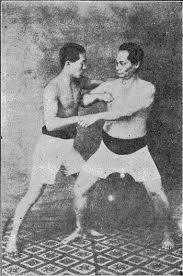
Sticky hands training occupies a realm where words struggle to reach. Its principles resist tidy explanation because the art itself is rooted in sensation — in the subtle intelligence of touch. Language can only gesture toward what must ultimately be felt. Through contact, the practitioner enters a domain of awareness that lies beyond verbal description.
Often referred to as pushing hands or Rou Shou/Tui Shou, sticky hands training explores sensitivity, listening, and the assimilation of force and energy. It transcends linguistic boundaries because its lessons are transmitted directly through touch. Even Google’s definition of “sense” — to feel or experience something without being able to explain exactly how — captures the essence of this practice more accurately than any technical explanation.
The Art of Real-Time Understanding
Sticky hands training cultivates the ability to read an opponent’s intention the instant contact is made. This information arrives not through thought but through sensation — a rapid, intuitive understanding that unfolds in fractions of a second. The quality of one’s response depends entirely on how clearly this information is absorbed and interpreted.
Mastery requires countless hours of practice with diverse partners, exploring drills that reveal the mechanics of absorption, redirection, and neutralization. Sticky hands is not a striking method nor a manipulation tool; it is an information-gathering system. Through it, the practitioner learns to perceive force, intention, and imbalance with remarkable clarity.
Parallel Training: Chi Gert and Leg Sensitivity
Just as the hands learn to listen, Chi Gert training teaches the legs to do the same. The principles mirror those of sticky hands: subtlety over strength, sensitivity over impact. This “listening energy” is distinct from the force used to strike. It is a refined quality of awareness that allows the body — not the conscious mind — to make decisions. In Tai Chi, this distinction is expressed as the difference between the body’s responsiveness and the mind’s intent, or Yi.
Forces, Balance, and the Dance of Interaction
The forces used for sticking and those used for striking are fundamentally different, yet both play essential roles. Sticky hands sequences involve assessing distance, angle, pressure, and the opponent’s use of limbs. Balance becomes the foundation of all movement; without it, neither manipulation nor impact can be effectively applied.
Through adherence, connection, and following, sticky hands evolves into an instantaneous response system. Pen Jing — the art of disrupting balance — becomes a central tool, leaving the opponent unable to move freely. When hands and legs coordinate seamlessly, the practitioner can redirect incoming force, often doubling its effect.
This entire process unfolds in the blink of an eye, creating the opening for a decisive strike. Tai Chi’s four primary hands, four corner hands, and the energies of striking, pulling, pushing, and joint manipulation all emerge naturally from this moment of intuitive clarity.
Intuition: The Heart of the Practice
The intuition developed through sticky hands is not the product of slow, deliberate thought. It is an instinctive guide forged through continuous contact. In real self-defence situations, this immediacy is essential; conscious reasoning is simply too slow.
Sticky hands training distinguishes between developing techniques and using them. The drills refine the practitioner’s tools, but the true goal is the cultivation of intuitive energy — the ability to respond correctly without thinking. This is the “sixth sense” of Tai Chi: a synthesis of refined perception that allows the practitioner to interpret touch-based information with effortless precision.
The Art Beyond Words
Ultimately, sticky hands training is an intricate dance of forces, a dialogue conducted through touch. It transforms tactile information into immediate, intelligent action. It teaches that martial arts are not merely about movement, manipulation, or impact, but about the seamless integration of all three into a unified, instinctive whole.
It is a journey into a realm where touch becomes language, where intuition becomes strategy, and where the practitioner learns to read and respond to the symphony of forces in an instant. Sticky hands training stands as a testament to the profound, word-defying nature of this ancient martial art.